by Imark | Sep 21, 2026 | Karate Classes North York
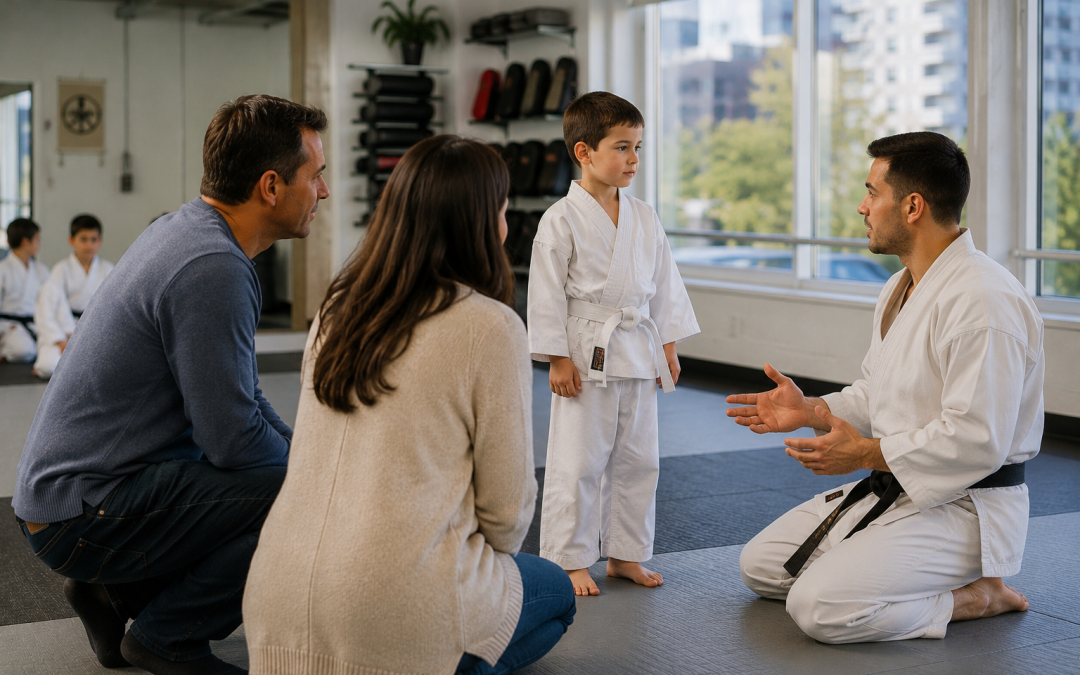
Choosing a martial arts programme for your child is about more than finding a convenient class time. Parents want a school where children can learn useful skills, stay active, build confidence, and feel supported. If you are researching karate classes North York families can consider, having a clear checklist can make the process much easier.
Every karate school has its own teaching style, class structure, and approach to working with children. Visiting a school and asking the right questions can help you decide whether it suits your child’s age, personality, and goals.
This guide covers the key factors North York parents should consider before enrolling their child.
1. Check the Instructor’s Experience
The instructor can have a major influence on your child’s experience. Look for teachers who have strong martial arts knowledge and understand how to work with children.
Teaching children requires more than knowing karate techniques. Instructors should be able to explain movements clearly, maintain an organised class, and encourage students without creating unnecessary pressure.
During a visit, watch how instructors interact with students. Do they give clear instructions? Do they correct mistakes respectfully? Do children appear engaged and comfortable?
These observations can tell you a lot about the school’s teaching approach.
Why Teaching Style Matters
Children learn differently from adults. Younger students often need simple instructions, repetition, encouragement, and activities that keep them focused.
A good karate school North York parents choose should create an environment where children can learn at an appropriate pace.
2. Look at the Class Structure
Before choosing a school, ask how classes are organised.
Age and experience can affect how children learn. A beginner should not necessarily train in the same way as an advanced student. Well-organised programmes often group students according to age, experience, or skill level.
Ask about:
- Class length
- Age groups
- Beginner programmes
- Skill levels
- Number of students per class
- Progression between levels
- Frequency of classes
The structure should be easy for parents to understand.
It should also give children enough time to practise skills while keeping lessons engaging.
3. Evaluate Safety Practices
Safety should be one of the first things parents consider when comparing kids karate classes North York options.
Karate involves physical movement, so children need appropriate supervision and a suitable training environment.
Look around the facility when you visit. Is the training area clean and well maintained? Is there enough space for students to move safely? Are children supervised throughout the class?
It is also reasonable to ask how instructors manage contact, falls, and physical drills.
A responsible school should have clear safety expectations and age-appropriate training methods.
4. Consider the School’s Approach to Children
A karate programme should support children’s development rather than focus only on physical techniques.
For many parents, qualities such as respect, discipline, patience, focus, and confidence are important reasons for choosing martial arts.
Pay attention to how these values appear during class.
For example, instructors may expect students to listen when others are speaking, treat training partners respectfully, and take responsibility for their equipment and behaviour.
These small habits can become an important part of the learning experience.
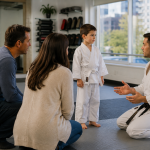
5. Visit Before You Enrol
Online research can help you create a shortlist, but visiting a karate school North York location can give you information that a website cannot.
Ask whether you can observe a class or speak with an instructor before making a decision.
During your visit, consider:
- How instructors communicate with students
- Whether children seem engaged
- How beginners are supported
- Whether the class feels organised
- How instructors manage different ability levels
- Whether the environment feels welcoming
Your child’s reaction matters too.
A programme may look excellent on paper, but your child should also feel comfortable with the instructors and environment.
6. Ask About Trial Classes
If a school offers a trial class or introductory session, it can be a useful way to evaluate the programme.
A trial gives your child an opportunity to experience the teaching style and class environment. It also lets you see how the instructor works with new students.
Afterwards, ask your child simple questions.
Did they enjoy the class? Did they understand the instructor? Did they feel comfortable? Would they like to return?
Their answers can provide valuable insight into whether the programme is a good fit.
7. Review the Progression System
Parents should understand how children progress through the programme.
Many martial arts schools use a belt system or another structured method to recognise development. However, the system should be more than a way to collect new belts.
Ask what students are expected to learn at each stage.
A useful progression system can give children clear goals. It can also help instructors track development and identify areas that need more practice.
Progress should not be rushed simply to move students to the next level.
The focus should remain on learning and developing skills properly.
8. Think About Your Child’s Goals
Not every child joins karate for the same reason.
One child may want to become more active. Another may be interested in martial arts itself. Some children may want to improve focus, confidence, coordination, or discipline.
Before choosing kids karate classes North York, think about what you and your child want from the programme.
Then ask the instructor how the programme supports those goals.
A good school should be able to explain what children can expect to learn without making unrealistic promises.
9. Check Class Times and Location
Practical factors matter.
Even an excellent karate programme may not work if its schedule conflicts with school, family commitments, or other activities.
Look at the weekly timetable and consider how easily your child can attend consistently.
For North York families, travel time can also affect long-term commitment. A convenient location may make it easier to maintain a regular routine.
Consistency is important in martial arts because children need repeated practice to build familiarity and confidence.
10. Understand the Costs
Parents should have a clear understanding of the total cost before enrolling.
Ask about tuition, registration fees, uniforms, grading fees, equipment, and any other expected expenses.
Do not judge a school based only on the lowest price.
Instead, consider what is included in the programme and whether the overall experience matches your family’s needs.
Transparency is important. A reputable school should be comfortable explaining its fees and policies before you commit.
11. Look for a Positive Learning Environment
Children spend a significant amount of time in their martial arts classes. The atmosphere can therefore have a major impact on whether they enjoy learning.
A positive environment should encourage effort and improvement.
Children should understand that making mistakes is a normal part of learning. Instructors can challenge students while still providing support.
This balance is particularly important for younger beginners.
The best karate classes North York parents consider should give children room to develop confidence without creating unnecessary fear of failure.
12. Consider the Long-Term Experience
Parents should think beyond the first few classes.
Ask what happens as children become more experienced. Are there opportunities to develop more advanced skills? Can students continue progressing as they get older?
A school that offers a clear long-term pathway can help children maintain interest.
It can also provide a familiar environment as their abilities develop.
For some families, this continuity is an important advantage because children can build relationships with instructors and classmates over time.
A Simple Parent’s Checklist
Before making your decision, use this quick checklist:
| What to Check |
Questions to Ask |
| Instructors |
Are teachers experienced with children? |
| Class structure |
Are groups organised by age or ability? |
| Safety |
Is training supervised and age appropriate? |
| Teaching style |
Are instructions clear and encouraging? |
| Progression |
How do students develop their skills? |
| Environment |
Does the school feel welcoming? |
| Schedule |
Can your child attend consistently? |
| Costs |
Are all fees explained clearly? |
| Trial class |
Can your child experience a class first? |
| Long-term fit |
Can the programme support continued learning? |
Using this checklist can help parents compare schools based on factors that actually affect their child’s experience.
Why the Right Fit Matters
There is no single karate school that will be perfect for every child.
Some children thrive in a highly structured environment. Others may need more encouragement before they become comfortable. Age, personality, confidence, previous experience, and personal goals can all influence the right choice.
That is why visiting schools and asking questions is so valuable.
When considering karate classes North York, parents should look for a programme that combines skilled instruction, appropriate safety practices, clear progression, and a positive learning environment.
Villari’s Martial Arts Centers provides a martial arts setting where students can work on their skills while developing values such as discipline, focus, confidence, and respect.
Ultimately, the goal is not simply to find a class that fits your schedule. It is to find an environment where your child feels motivated to learn and has the opportunity to grow.
Final Thoughts
Choosing martial arts training programs is an important decision for any parent. The right programme can become a positive part of a child’s weekly routine and support development both inside and outside the training environment.
If you are comparing karate school North York options, take your time. Visit the school, observe a class, meet the instructors, ask about safety, and consider your child’s own response to the environment.
Most importantly, look beyond flashy demonstrations or quick promises. Focus on teaching quality, consistency, respect, safety, and the overall experience.
With the right programme, karate can give children more than physical skills. It can provide a structured setting where they practise patience, develop confidence, learn to work towards goals, and build habits that can support them as they grow.
Frequently Asked Questions
1. What should parents look for in a karate school?
Parents should consider instructor experience, class structure, safety, teaching style, school culture, progression, schedule, cost, and whether the programme suits the child’s needs.
2. Are kids karate classes North York suitable for beginners?
Yes. Beginner programmes are designed to introduce children to basic martial arts skills and help them become comfortable with the training environment.
3. How can I choose the right karate school North York for my child?
Visit the school, observe a class, speak with instructors, ask about safety and progression, and consider whether the environment matches your child’s personality and goals.
4. Should my child try a class before enrolling?
If a trial or introductory class is available, it can be helpful. Your child can experience the teaching style and decide how comfortable they feel.
5. How often should children attend karate classes?
The ideal schedule depends on the child’s age, goals, and family routine. Consistent attendance is generally more useful than attending sporadically.
6. Does karate teach more than physical techniques?
Yes. A well-structured programme can also encourage discipline, focus, respect, confidence, coordination, and goal setting.
by pmalfara | Aug 14, 2026 | Martial Arts Training Programs
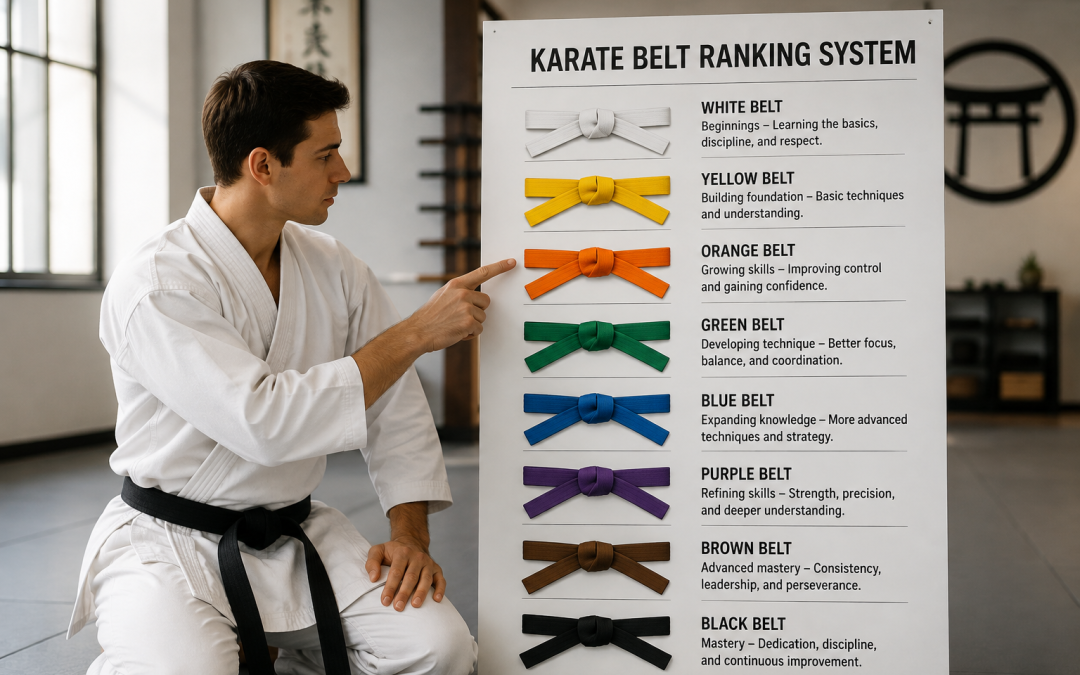
For students and parents considering martial arts training programs, the belt system can be one of the most interesting parts of the journey. A belt is not simply a colour worn around the waist. It represents progress, effort, skill development, discipline, and the ability to apply what a student has learned.
At Villaris Martial Arts Centres, students follow a structured learning path designed to develop technical skills, confidence, fitness, self-defence abilities, and character. The progression gives students clear goals while allowing instructors to assess development at each stage.
However, it is important to understand that belt colours and grading requirements can vary between martial arts schools and styles. The meaning behind progression is often more important than the colour itself.
Why Do Martial Arts Training Programs Use Belts?
A belt system gives students a clear way to measure their progress. Martial arts can involve many techniques, from basic stances and strikes to more advanced combinations and self-defence movements. Without a structured system, it can be difficult for students to see how far they have come.
A belt can provide a visible reminder of that progress.
For younger students, this can also make training more engaging. Reaching the next level creates a realistic goal to work towards. Adults can benefit in the same way, especially when they are starting martial arts for the first time.
A good ranking system also encourages students to focus on learning rather than rushing ahead. Each level should build on skills learned previously.
What Does a White Belt Mean?
The white belt traditionally represents the beginning of a student’s martial arts journey. It is the stage where students become familiar with the basic principles of training.
A new student may learn:
- Basic stances and movement
- Fundamental strikes and kicks
- Simple blocks
- Balance and coordination
- Class etiquette
- Basic self-defence concepts
- How to listen and respond to instruction
At this stage, the goal is not perfection. Beginners are learning how to move correctly and understand the expectations of martial arts training.
For parents, this stage is also useful because it allows children to build confidence gradually. They do not need previous experience to get started. Villaris states that beginners are welcome and that fundamental techniques are taught step by step.
What Do Intermediate Belts Represent?
As students progress, the focus shifts from simply learning individual movements to combining techniques and applying them with better control.
Intermediate belts generally represent a growing level of:
- Technical knowledge
- Physical control
- Coordination
- Focus
- Confidence
- Discipline
- Self-defence awareness
Students are expected to remember more techniques and perform them with greater accuracy.
This stage can also teach an important lesson: progress does not always happen at the same speed. Some techniques may feel easy, while others require repeated practice.
That experience can help students understand the value of patience and consistent effort.
How Martial Arts Training Programs Build Progress
Effective martial arts training programs do not treat belt advancement as simply learning a list of movements. Progress should involve several areas of development.
Technical Development
Students need to demonstrate that they understand the techniques required at their current level. This includes proper movement, balance, timing, and control.
Physical Development
Martial arts training can improve fitness, flexibility, coordination, strength, and endurance. Villaris’ programs are designed for different age groups and experience levels, with fitness and physical conditioning forming part of the training experience.
Mental Development
Students also learn to focus during lessons. They must listen, remember instructions, correct mistakes, and stay engaged.
Character Development
Perhaps the most important part of progression is character. Students are encouraged to develop qualities such as discipline, responsibility, perseverance, honesty, and respect.
This is why a belt should never be viewed as a reward for attendance alone.
What Does a Brown Belt Represent?
In many karate systems, brown belts are associated with advanced student development. By this point, students have usually spent considerable time building their foundations.
The emphasis often shifts towards refinement.
A student may be expected to demonstrate:
- Stronger technical control
- Better timing and accuracy
- Improved physical conditioning
- Greater awareness during partner work
- More consistent discipline
- A deeper understanding of self-defence principles
At this level, students may also begin to understand that knowing a technique and performing it effectively are two different things.
Repeated practice helps turn knowledge into skill.
What Does a Black Belt Actually Mean?
A black belt is often seen as the final destination of martial arts. In reality, it is better understood as an important milestone.
Earning a black belt does not mean that a student knows everything. Instead, it demonstrates a strong foundation, commitment, technical development, and the ability to continue learning at a more advanced level.
For many students, reaching this stage requires years of regular training.
A black belt can represent:
- Long-term commitment
- Consistent practice
- Self-discipline
- Technical proficiency
- Mental resilience
- Personal growth
- Respect for the martial arts
The most valuable achievement may not be the belt itself. It is the person the student becomes while working towards it.
Is Every Karate Belt the Same?
No. This is an important point for parents and prospective students.
Different martial arts schools may use different belt colours, ranking structures, grading intervals, and requirements. Even schools teaching related styles may organise their progression differently.
Therefore, students should not assume that a particular colour always represents exactly the same level everywhere.
The martial arts training programs at Villaris follow a structured progression. The school’s curriculum is designed to introduce techniques step by step while providing measurable achievements and advancement.
This approach helps instructors assess students based on their actual development rather than simply the amount of time they have attended.
What Happens During a Belt Assessment?
A belt assessment is an opportunity for an instructor to evaluate whether a student is ready for the next stage.
Depending on the student’s level, assessment may consider:
- Technique: Can the student perform the required movements correctly?
- Control: Can techniques be performed safely and with appropriate control?
- Knowledge: Does the student understand the techniques being taught?
- Fitness: Can the student complete the physical requirements of their level?
- Focus: Can the student remain attentive throughout training?
- Attitude: Does the student show respect, discipline, and a willingness to learn?
This broader approach helps make belt progression meaningful.
Why Belt Progression Matters for Children
For children, martial arts progression can provide lessons that extend beyond the dojo.
A child may initially struggle with a technique. With regular practice, they eventually improve. That experience can teach them that mistakes are part of learning.
They also learn that improvement requires effort.
The benefits can include:
- Greater confidence
- Improved concentration
- Better coordination
- Increased discipline
- Greater respect for others
- Stronger perseverance
- More confidence when facing challenges
Villaris’ children’s programs focus on skills such as discipline, confidence, respect, coordination, fitness, and self-defence in an encouraging environment.
Martial Arts Classes Canada: What Should Parents Look For?
When comparing martial arts classes Canada families should look beyond the belt colours.
A strong program should provide clear instruction and a safe environment. Parents should also consider the experience of instructors, class structure, age-appropriate teaching, and how student progress is measured.
Ask questions such as:
- Is the curriculum clearly structured?
- Are beginners supported?
- Are children taught according to their age and ability?
- Does the program focus on character as well as technique?
- Are instructors properly trained?
- Can parents understand how progression works?
Villaris offers programs for children, teens, adults, and families, with instruction adapted to age, experience, fitness, and individual goals.
How Shaolin Kempo Karate Canada Fits Into Belt Progression
Students interested in Shaolin Kempo Karate Canada may also want to understand how the style approaches martial arts development.
Shaolin Kempo Karate combines elements associated with Shaolin Kung Fu, Kempo, traditional Karate, Western boxing, Jujutsu, Chin Na, and grappling arts.
This creates a broad training system that includes striking, kicking, movement, self-defence, and grappling concepts.
At Villaris, this training is supported by a structured curriculum that develops students progressively. The goal is to help students build practical skills while also developing mental focus and personal discipline.
Belt Colour Is Only One Part of the Journey
It is easy to focus on the colour around a student’s waist. However, the real value of martial arts progression lies in what happens between each grading.
A student who earns a new belt has hopefully gained more than another colour. They have spent time learning, practising, making mistakes, improving, and becoming more confident.
For parents, this is one reason to look closely at the teaching philosophy behind different martial arts training programs.
The right program should make progression understandable while keeping the focus on genuine development.
Final Thoughts
The karate belt ranking system provides students with a clear path through their martial arts journey. From the first lessons as a beginner to the discipline required for advanced training, every stage offers an opportunity to learn and improve.
While belt colours can differ between schools, the core idea remains valuable: progress should reflect consistent effort, growing skill, personal discipline, and a willingness to keep learning.
At Villaris Martial Arts Centres, structured progression is combined with fitness, self-defence, confidence, and character development. The school offers children’s, adult, and family programs for students at different experience levels.
For anyone considering martial arts training programs, understanding the ranking system is a useful first step. More importantly, prospective students and parents should choose a school where instructors explain the journey clearly and support students throughout every stage.
FAQs
1. How long does it take to earn a black belt?
There is no single timeframe that applies to every student. Progress depends on factors such as attendance, practice, skill development, fitness, and the school’s grading structure.
2. Do beginners need martial arts experience?
No. Beginners can start without previous martial arts experience. Villaris specifically welcomes beginners and teaches fundamental techniques step by step.
3. Are belt colours the same in every karate school?
No. Belt colours, grading systems, and requirements can vary between martial arts styles and schools. It is best to ask the individual school about its ranking structure.
4. Is karate suitable for children?
Yes. Age-appropriate karate programs can help children develop coordination, fitness, confidence, discipline, focus, and self-defence skills. Villaris offers children’s martial arts programs designed around these areas.
5. Can adults start martial arts training as beginners?
Yes. Adults do not need previous experience to begin. Villaris offers adult programs for different fitness and experience levels, with an emphasis on self-improvement, conditioning, confidence, and self-defence.